 🌻 The Sunflower Lanyard Program: A Practical Advocacy Tool for Neurodiverse Individuals and Families
As a Registered Psychotherapist who works closely with neurodiverse individuals and families, I’m often asked about practical, real-world supports that can make overwhelming environments more manageable — particularly during travel.
Airports, crowds, noise, time pressure, security procedures, and unfamiliar routines can be incredibly stressful for neurodivergent individuals, children with special needs, and their caregivers. One tool I regularly discuss with families is the Hidden Disabilities Sunflower Lanyard Program.
This post is intended to be a clear, accessible resource explaining:
-
What the Sunflower Lanyard Program is
-
Who it’s for
-
Whether ID cards are required
-
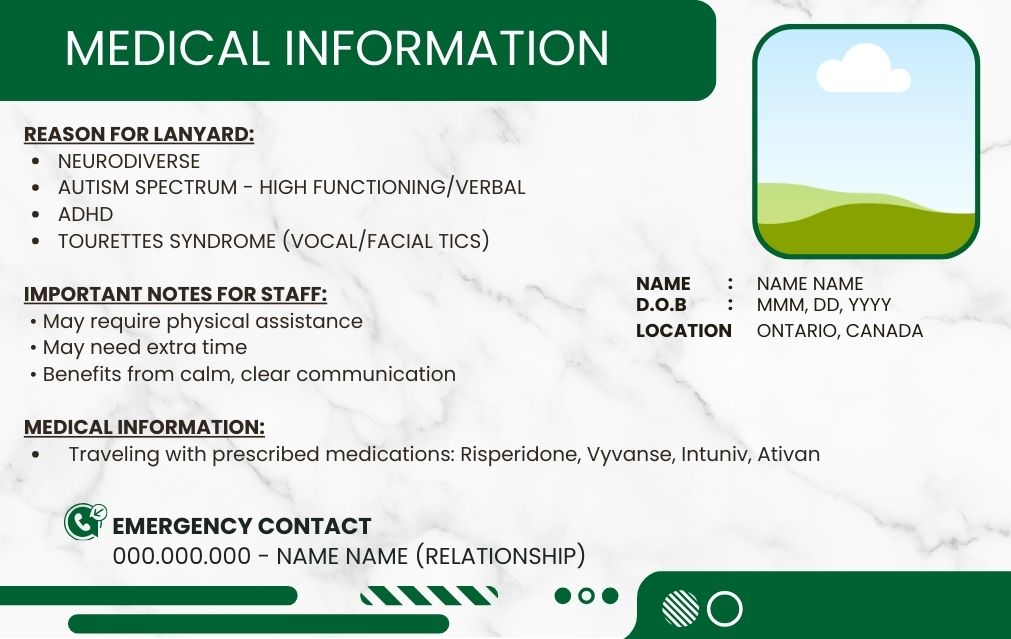
How to create your own ID card
-
Where to get a sunflower lanyard (and how much they cost)
-
How this fits into broader advocacy and support for special needs families
I’ll also share my new YouTube video and a free Canva ID card template you can download and use immediately.
🌻 What Is the Sunflower Lanyard Program?
The Hidden Disabilities Sunflower is an internationally recognized symbol that discreetly signals a person may have a non-visible disability or condition and could benefit from extra time, patience, understanding, or assistance.
It is commonly recognized in:
-
Airports and airlines
-
Public transportation systems
-
Retail and service environments
-
Healthcare settings
-
Tourist attractions
Importantly, wearing a sunflower lanyard does not mean someone must disclose a diagnosis or explain themselves. It is a voluntary communication tool, not a medical label.
🌻 Who Is the Program For?
The program is intentionally broad and inclusive. It may support individuals with:
-
Neurodivergence (ADHD, autism, learning differences)
-
Sensory processing differences
-
Physical disabilities that may not be immediately visible
-
Anxiety or cognitive differences
-
Chronic illness
-
Communication challenges
There is no “right” or “wrong” reason to use a sunflower lanyard. Families and individuals decide for themselves whether it feels helpful.
🌻 Is an ID Card Required?
No — an ID card is not required to wear a sunflower lanyard.
However, many individuals and families choose to attach a small ID card because it can:
-
Reduce the need to repeatedly explain needs
-
Support communication during high-stress moments
-
Help staff respond more appropriately
-
Be especially helpful for children, teens, or individuals who struggle with self-advocacy
An ID card is simply a communication aid, not an official document.
🌻 Can You Create Your Own ID Card?
Yes — absolutely.
There are no rules or restrictions preventing individuals or families from creating their own ID card to attach to a sunflower lanyard. No registration, proof, or diagnosis is required.
From a therapeutic perspective, this is important. Advocacy should feel empowering, not invasive. Families get to decide:
-
What information is shared
-
How much detail feels safe
-
What language feels respectful and neutral
🌻 Best Practices When Creating an ID Card
While there are no official requirements, I generally recommend keeping ID cards:
✔ Minimal and factual
✔ Easy to scan quickly
✔ Calm and respectful in tone
Helpful information may include:
-
Name (first name or full name)
-
“Sunflower Lanyard – Additional Support May Be Required”
-
Broad support needs (e.g., extra time, calm communication)
-
Emergency contact information (especially for children)
-
Medical information only if relevant and helpful
Avoid including anything that feels overly personal or stigmatizing. The goal is clarity — not explanation.
🌻 Where Can You Get a Sunflower Lanyard?
✅ Official Hidden Disabilities Sunflower Store
The most widely recognized source is the Hidden Disabilities Sunflower online store:
Typical pricing:
-
Sunflower lanyard with ID card pack: approximately $15 CAD/USD
-
Individual lanyards and badge holders are similarly priced
✈️ Free Lanyards at Airports
Many airports provide free sunflower lanyards at:
-
Information desks
-
Accessibility or customer service counters
In Canada, this includes major airports such as Toronto Pearson, Vancouver (YVR), and Calgary (YYC), among others. Availability varies by airport, but many travellers are surprised to learn they don’t need to purchase one in advance.
🛒 Other Retail Options
Sunflower lanyards and badge holders can also be found on platforms like Amazon or Etsy, typically ranging from $10–$20 CAD. These may not always be official program products, but are still commonly recognized.
🎥 Watch: My New YouTube Video on the Sunflower Lanyard Program
I recently created a YouTube video where I:
-
Explain the Sunflower Lanyard Program in more detail
-
Talk through how families use it in real-life situations
-
Share considerations for children, teens, and adults
-
Walk through how to create your own ID card
-
Discuss advocacy, accommodations, and sensory needs
👉 https://youtu.be/8yGIY975Jd4